


Headingley Karate
|
|
|
Principles of Combat
Rather than simply being a random collection of different techniques Shinseido embraces a number of core principles. Any Shinseido technique should use most, if not all, of these principles. Our core principles include:
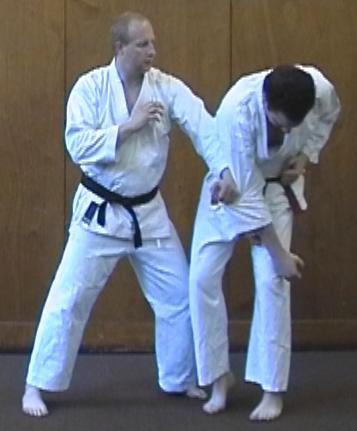
A blocking technique that employs all 5 core principles
|
- Sticking - keeping in contact with the assailant makes it easier to control their movements and avoid being struck yourself.
This is due to the body’s natural ‘proprioceptive’ abilities (ie. your inbuilt ability to know where every part of your body is in relation to the other parts.
If you know where your arm is and its in contact with the aggressor's arm, then you also know exactly where their arm is).
- Unbalancing - the art of unbalancing the assailant whilst keeping your own balance.
Whilst the assailant is unbalanced they cannot strike with power and will be too busy trying to ‘right’ themselves to be able to defend against your techniques.
- Bodyweight - using your relaxed bodyweight, coordinated with the breath, to develop power, rather than relying on muscular strength.
- Moving to a position of advantage - seeking to place yourself in a position from which you can easily strike the assailant but they cannot strike you.
- Distance - controlling the distance between you and an assailant.
Click here for more information on Distance.
- Gross motor movements - Rather than using ‘fine motor skills’ which involve great accuracy and dexterity, wherever possible use ‘gross motor skills’, ie. techniques should work by moving the limbs move in ‘broad brush strokes’.
These principles are discussed in more detail in the second part of this article.
Further information on the Principles of Combat can be found by reading Vince Morris’ excellent book Rules of Combat: The Development of Warrior Tactics.
To learn more come along for a FREE trial lesson.